The Reserve Bank of India has increased the benchmark repo rate by 25 basis points to 5.5%, marking a notable change in its monetary policy approach. The decision comes after a period of stable interest rates and reflects the central bank’s assessment of changing inflationary pressures and broader financial conditions.
The latest move means banks will face a higher cost when accessing short-term funds from the RBI. This can eventually influence lending rates across the banking sector, affecting the cost of borrowing for households and businesses. Customers with floating-rate loans could see their interest burden rise depending on how banks transmit the policy change.
The Monetary Policy Committee has also altered its policy stance, signalling a move towards tighter monetary conditions. The shift indicates that controlling inflation is becoming a stronger priority for the central bank as it assesses the risks facing the economy.
Inflation has remained an important consideration behind the decision. Rising input costs, movements in global commodity prices and uncertainty surrounding crude oil prices can put pressure on consumer prices. For an economy that imports a significant portion of its energy requirements, sustained increases in international oil prices can also affect transportation, manufacturing and logistics costs.
At the same time, the RBI continues to maintain a positive view of India's growth prospects. Economic activity has remained resilient, supported by domestic consumption, investment and improving business conditions. The challenge for policymakers is therefore to maintain this growth momentum while preventing inflationary pressures from becoming persistent.
The higher repo rate could have a mixed impact on different sections of the economy. Banks may benefit from stronger interest income, while borrowers could face increased financing costs. Companies planning capital expenditure or relying on loans for working capital may need to reassess their borrowing plans if lending rates move higher.
Small and medium-sized enterprises could be particularly sensitive to changes in credit costs. For businesses operating with limited cash reserves, even a modest increase in interest expenses can affect expansion plans and operating margins. On the other hand, stronger deposit rates could make traditional savings products more attractive to households.
The decision is also significant for financial markets. Investors are likely to closely monitor future inflation readings, crude oil prices, liquidity conditions, credit growth and global economic developments to assess whether the RBI will maintain its tighter approach or adjust its stance in subsequent policy meetings.
For consumers, the most visible impact could come through borrowing costs. Home loans, vehicle loans, personal loans and other credit products linked to floating interest rates may become more expensive if banks pass on the increase. Existing borrowers could therefore see changes in their monthly repayment obligations over time.
Businesses, meanwhile, will need to consider the new interest-rate environment while making decisions on expansion, investment and financing. Sectors that depend heavily on affordable credit could experience greater pressure, while companies with strong balance sheets and lower debt exposure may be better positioned to manage the change.
The repo-rate hike ultimately reflects the RBI’s attempt to balance two competing priorities: maintaining India's strong economic momentum and keeping inflation under control. With growth remaining comparatively robust but price pressures requiring greater attention, monetary policy is likely to remain an important factor for businesses, investors and consumers in the months ahead.
The latest move could therefore influence not just bank lending rates but also investment decisions, household spending, corporate borrowing and overall financial conditions. Market participants will now be watching incoming economic data closely for clues about the direction of India's monetary policy.
Economics
Oct 07, 2026
RBI Raises Repo Rate by 25 Bps to 5.5% Amid Evolving Economic Conditions
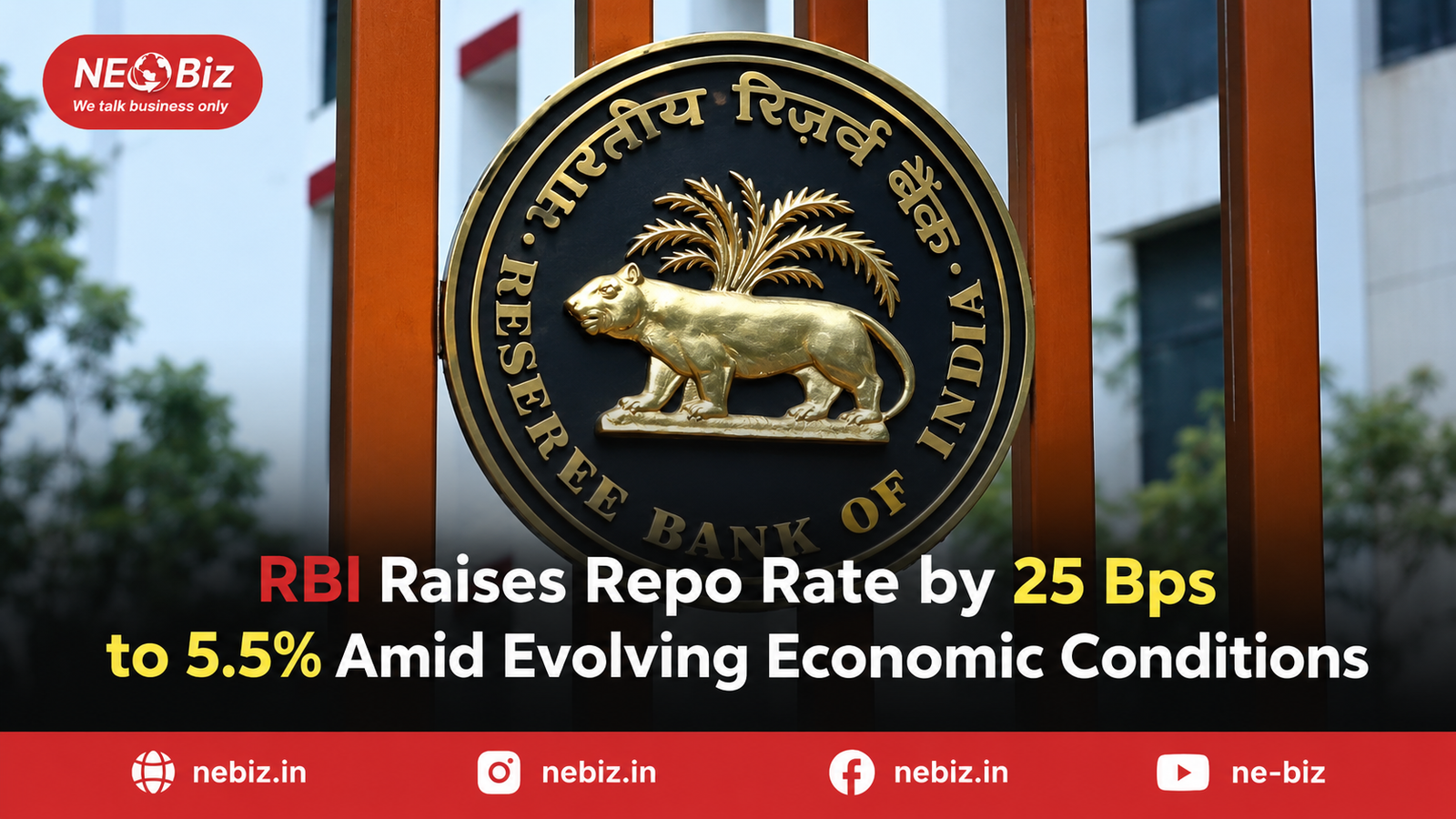
The Reserve Bank of India has increased the benchmark repo rate by 25 basis points to 5.5%, marking a notable change in its monetary policy approach. The decision comes after a period of stable interest rates and reflects the central bank’s assessment of changing inflationary pressures and broader financial conditions.
Follow Us
Latest News

October 10, 2026
Meghalaya Partners TERI to Strengthen Renewable Energy and Storage Infrastructure

October 10, 2026
Meghalaya’s Megha-1 Turmeric Heads to Singapore, Opening New Export Opportunities

October 10, 2026
Meghalaya Partners with Bharti Airtel Foundation to Strengthen Teacher Training

October 10, 2026
Meghalaya’s Indigenous Sohiong Fruit Set for Commercial Growth with ICAR Support

October 9, 2026