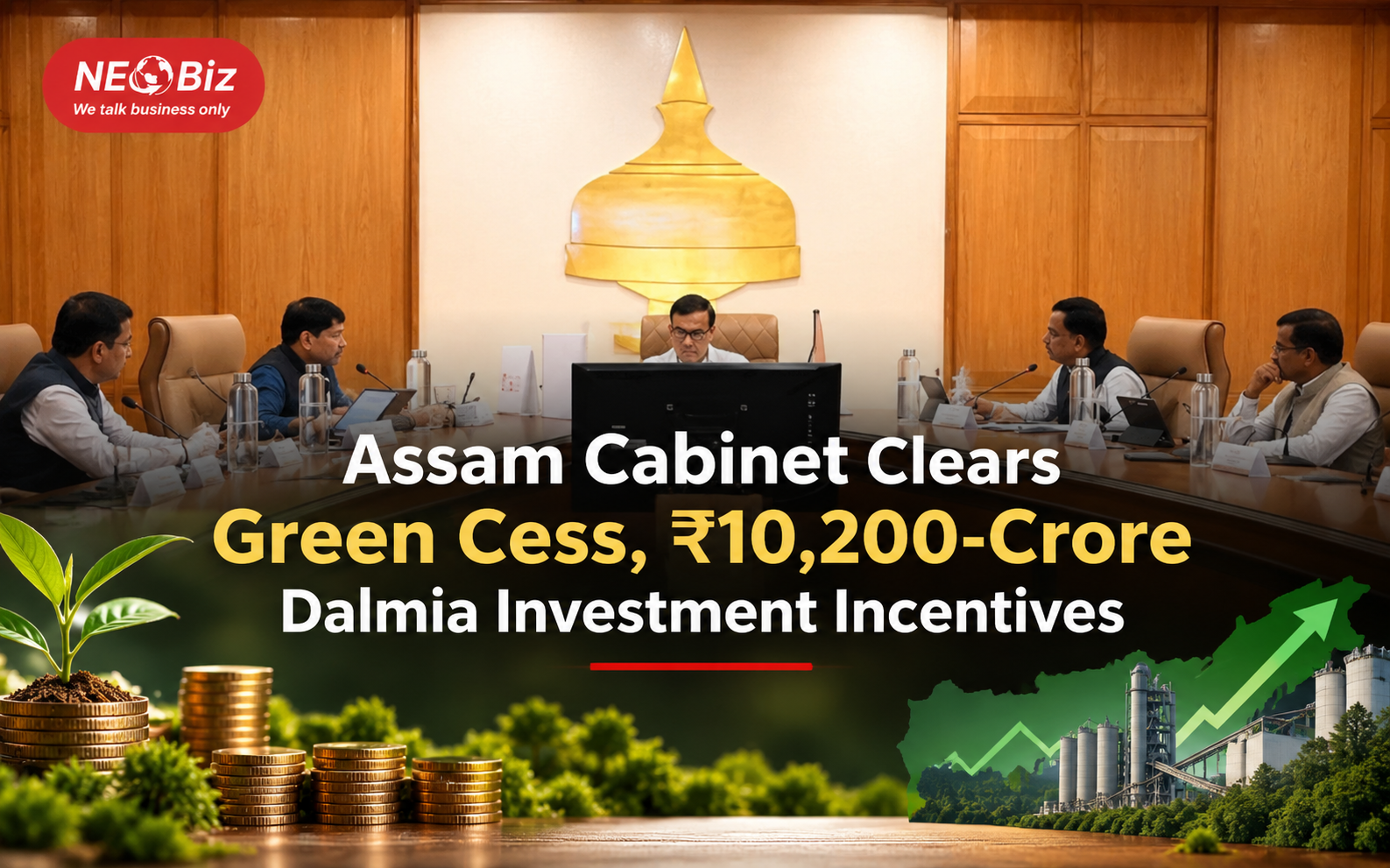
The Assam government has approved a series of decisions focused on industrial growth, environmental conservation, infrastructure development and public investment. Among the key decisions taken by the state Cabinet are the introduction of a green cess on the transfer of ownership of certain older vehicles and customised incentives linked to Dalmia Bharat Green Vision’s proposed ₹10,200-crore clinker manufacturing investment in Assam.
Under the new green cess provision, a charge of ₹3,000 will be imposed when cars that are more than three years old are sold or purchased through a change in ownership. Electric vehicles, CNG vehicles, two-wheelers and three-wheelers have been kept outside the scope of the levy. Transfers resulting from the death of a vehicle owner will also be exempt. The revenue generated through the cess is expected to support environmental initiatives such as afforestation and conservation.
The Cabinet’s approval of customised incentives for Dalmia Bharat Green Vision is another significant development for Assam’s industrial sector. The company is planning clinker manufacturing units involving an investment of around ₹10,200 crore. The project could strengthen the state’s manufacturing ecosystem and create additional demand for logistics, transportation, construction, engineering and other supporting services.
Large-scale industrial investments can also generate indirect economic activity by creating opportunities for local suppliers and service providers. The proposed project could therefore contribute to the expansion of Assam’s industrial and supply-chain network while supporting employment and related economic activity.
The Cabinet has also approved changes related to the management of National Highway works under the Public Works Department. The National Highway component will be separated from PWD (Buildings and NH) and placed under PWD (Roads), with the objective of improving the administration and execution of road infrastructure projects.
Another major infrastructure-related decision concerns the second phase of the Brahmaputra Riverfront Development Project in Guwahati. Tata Consulting Engineers has been assigned the task of preparing the Detailed Project Report for the next phase, covering the stretch from Kachari Bazar towards the foothills of Nilachal Hills.
The continued development of the Brahmaputra riverfront could have wider implications for Guwahati’s urban infrastructure, tourism and commercial activity. Better-developed public spaces and supporting infrastructure along the river could also create opportunities for businesses operating in hospitality, tourism, retail and other service sectors.
The state Cabinet has further approved an arrangement with the Bodoland Territorial Council, Dima Hasao and Karbi Anglong autonomous council areas for rural water supply initiatives under the Jal Jeevan Mission and associated schemes. The move is aimed at strengthening coordination for the implementation and management of water infrastructure across these areas.
In another allocation, the government has approved ₹10 crore for infrastructure development at the Assam Regimental Centre in Shillong.
The latest decisions reflect Assam’s broader focus on attracting private investment while expanding public infrastructure and creating mechanisms to support environmental programmes. The Dalmia project, in particular, could become an important addition to the state’s industrial landscape if the proposed investment progresses as planned.
For businesses across Assam, increased industrial investment and infrastructure development could create opportunities in areas such as logistics, construction, manufacturing, transportation, engineering and professional services. At the same time, the green cess introduces an environmental financing mechanism into vehicle ownership transfers.
Overall, the Cabinet’s decisions bring together industrial incentives, infrastructure expansion and environmental measures, signalling the state government’s continued emphasis on strengthening Assam’s economic base while addressing sustainability and long-term development needs.